Internet of Things - IOT

Internet of Things -IOT online training course is a comprehensive training course for Internet of Things (IoT). You will learn IoT introduction, significance, building your own IoT devices, sensors, IoT communication and security.

  • 20000
  • 25000
  • Course Includes
  • Live Class Practical Oriented Training
  • 60 + Hrs Instructor LED Training
  • 45 + Hrs Practical Exercise
  • 25 + Hrs Project Work & Assignment
  • Timely Doubt Resolution
  • Dedicated Student Success Mentor
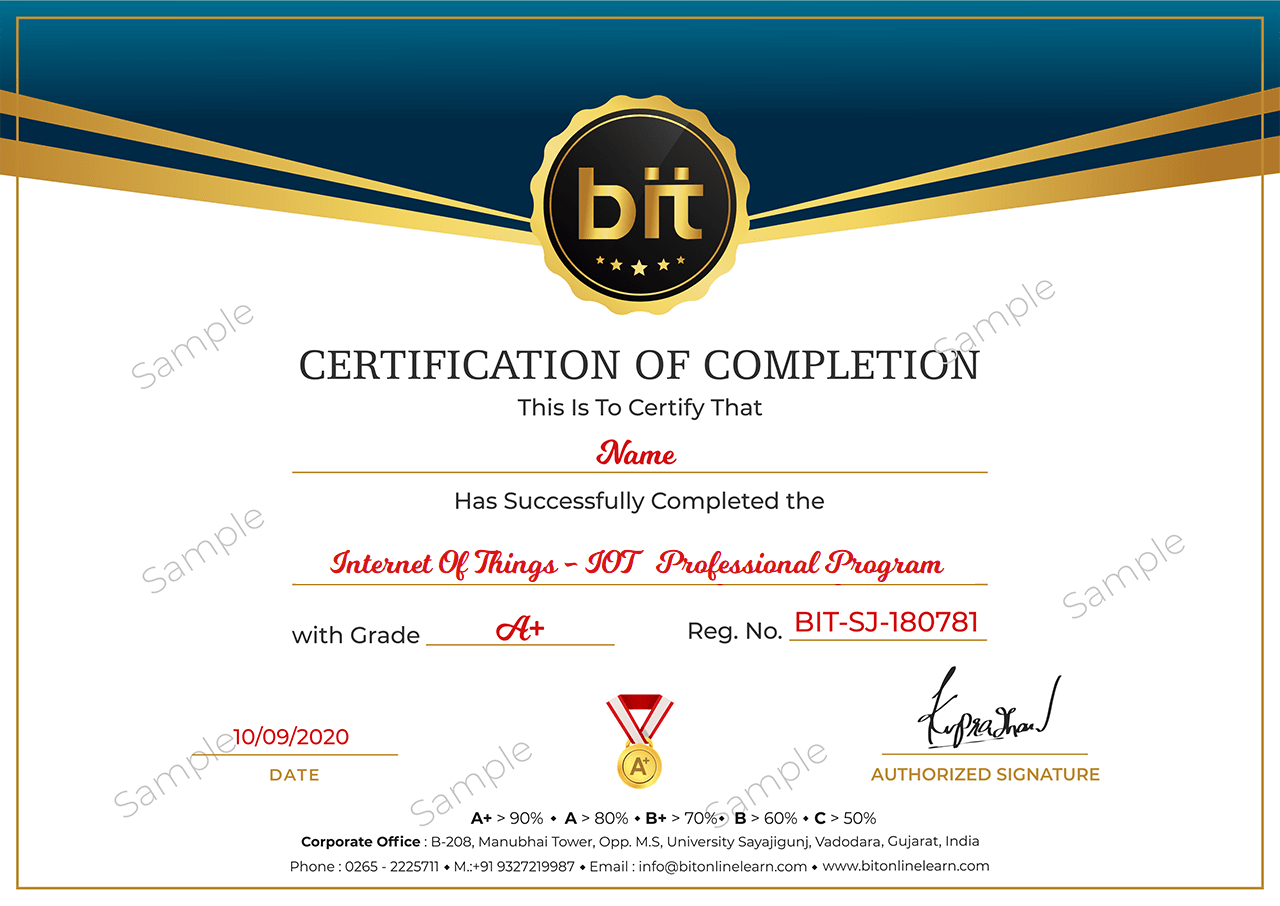
  • Certification & Job Assistance
  • Free Access to Workshop & Webinar
  • No Cost EMI Option


Have Query ?

What you will learn

  • Architecture of Internet of Things. IoT components, devices, hardware and software requirements
  • Various layers of IoT infrastructure. IoT embedded systems and micro-controllers
  • Working with Big Data and deploying Data Analytics. Arduino and Raspberry Pi interface for IoT
  • USB, HDMI and Ethernet protocols of IoT communication. Controlling physical IoT devices like switches, motors and sensor...
  • Programming for IoT components and systems. IoT support, security, testing, compliance and data management

Requirements

  • There are no prerequisites for taking up this IoT training course.

Description

|| About Internet of Things - IOT Training Course

Internet of Things -IOT online training course covers the Raspberry Pi Platform, and the Arduino environment for building devices that can control the physical world.IoT – Fundamentals with Raspberry Pi3 is known as the introductory course on IoT, whereas, it is not considered as the introductory on Raspberry Pi3. If you are exploring the opportunities of Internet of Things (IoT) using Raspberry Pi, then start learning from IOT – Fundamentals with Raspberry Pi3. The course is about to interface with physical devices that works as a mediator or supplier (information/data). By joining the training of this course candidate will experience, how the implementation of IoT within the device will change the operational possibilities. You do not require changing anything in your current computer system, through this course you will also learn, how to access the overall GUI of the Raspberry Pi in your Windows computer. Along with the basic knowledge you will also learn the elimination of flash drive and sharing the files between windows computer and Raspberry Pi. Internet of Things (IoT) training course that lets you learn the complete aspects of the IoT technology. Once you complete the course, you will be well-versed in building your own IoT devices and sensors, and you will also be able to deploy this technology for communication and security.

Course Content

Live Leture

·       Introducing the Internet of Things

·       The various types of devices connected to the internet

·       Components of IoT devices

·       Design considerations

·       IoT device and physical world interfacing

·       Hardware and software trade-offs

·       IoT simulators OpenWSN and Cooja

·       IoT and how the embedded systems work

·       Working with Big Data, Cloud, Analytics
Live Leture

·       The IoT Stack Architecture

·       The various components and layers

·       The app, the data processing and platform

·       IoT OS likeContiki, FreeRTOS and mbed

·       The edge and the connected thing or device

·       aPaaS

·       Data management

·       Middleware

·       Device management

·       Device hub/gateway

·       Sensors

·       Hardware/firmware

·       Embedded devices NodeMCUandNetduino for C#

Live Leture

·       The open source IoT platform built using easy to use hardware and software

·       Arduino physical board

·       Libraries

·       The Integrated Development Environment

·       Arduino Shields various operations like heat and light sensing

·       GPS

·       UI display

·       Programming Arduino using C language

·       Controlling external devices using pins on the Arduino board

Live Leture

·       The Arduino interface

·       Reading inputs from various sources

·       Providing an output

·       Working with sensors

·       Sensing and controlling the physical world,

·       Deploying various types of sensors and connecting it to the Arduino

·       Constant conversion between analog and digital signals for information exchange between the physical and digital domains

·       Programming for this type of signal conversion

·       Arduino-specific shields

·       Shields software libraries

·       Real-time demo of Arduino interfacing.