
Primavera Training Course

Learn how to plan, manage, and execute projects, as well as allocating resources, tracking project progress, and fostering team collaboration through BIT’s Primavera P6 online training.

  • 22000
  • 25000
  • Course Includes
  • Live Class Practical Oriented Training
  • 60 + Hrs Instructor LED Training
  • 45 + Hrs Practical Exercise
  • 15 + Hrs Project Work & Assignment
  • Timely Doubt Resolution
  • Dedicated Student Success Mentor
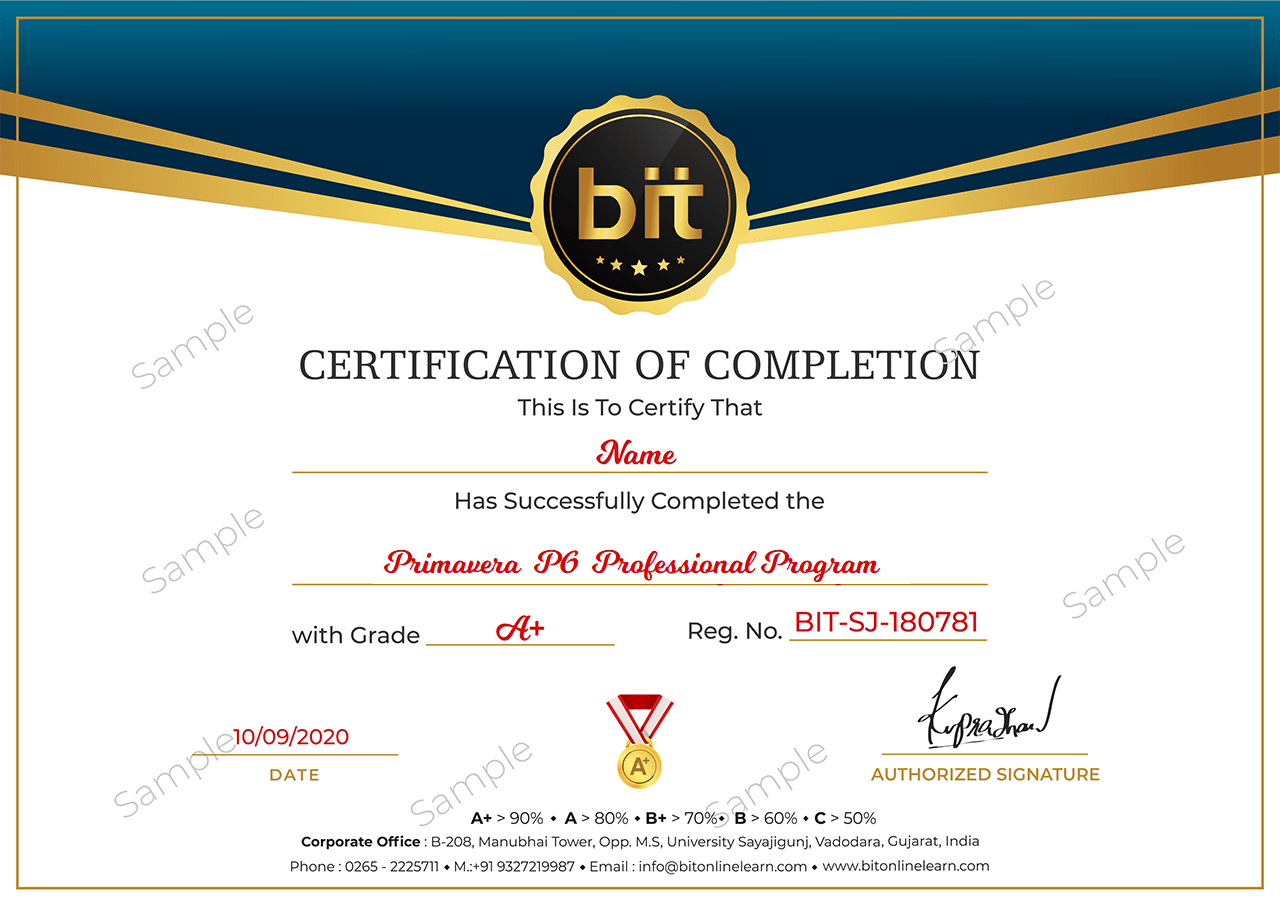
  • Certification & Job Assistance
  • Free Access to Workshop & Webinar
  • No Cost EMI Option


Have Query ?

What you will learn

  • Create a Work Breakdown Structure.
  • Schedule project and assign constraints.
  • Assign roles and resources. Analyze portfolio performance.
  • Customize dashboards. Execute the project within budget constraints and time.
  • Plan, schedule, and organize project activities. Apply industry best practices in project management.
  • Understanding of Primavera Interface Define Work Breakdown Structure (WBS)

Requirements

  • Basics of Project Management

Description

|| About Primavera Training Course

BIT’s Primavera P6 online training provides in-depth knowledge and hands-on experience to implement Project Portfolio Management solutions through real-time use cases. Our online classes cover all the core elements of Oracle Primavera such as Enterprise Data Structures, Portfolio and Project Configuration, Administrative Functions, etc., and help you to easily get through the Primavera P6 certification. Project time management and utilization are complex tasks within their own premises; the use of complex tools and applications further adds to these complexities, adding to the issues faced by project managers. Oracle’s Primavera P6 training is an example of such applications. We have managed to develop a highly simplified Primavera P6 course which aims at cutting down on your learning time and to enable you to understand the software better.


Oracle’s Primavera P6 Training has often been found to be intimidating and confusing, even by trained and experienced project personnel, which highlights the important need for repeated training and referral to related informative content. This is why this course has been formulated! The course has been developed in a manner that would help to reduce the confusion and obstacles that hinder understanding the software out of the trainees’ mind, helping them to better understand the software and its application, thereby making it seem less complex and intimidating. The course has been created in a manner that utilizes the practice of the application, thereby helping to embed how the application performs in the case of real life scenarios. 


Our aim is to help you enhance your understanding of the Oracle Primavera P6. Whether your aim is to clear any ambiguities about the software and its process, or you just wants to polish or enhance your skills: this course is bound to cater to all your varying needs regarding the primavera p6 professional training. Anyone with a clear understanding of the Primavera P6 as scheduling software will be in a better situation to produce effective and efficient project schedules which can enable the project manager to manage projects in an enhanced manner, helping to ensure the success of the project.


Course Content

Live Lecture

·     Project Management

·     Planning

·     Introduction to Basic Terminology of Project Management – Activities

·     Duration

·     Predecessor

·     Successor

·     Relationships

·     Leads

·     Lags

·     Practical Exercise
Live Lecture

·     Schedule Network Techniques

·     Early and Late start/Finish dates

·     Critical Path

·     Critical Activity

·     Gantt Chart

·     Practical Exercise

Live Lecture

·     Uses and Advantages of Primavera P6

·     Introduction to P6 Interface

·     Practical Exercise

Live Lecture

·     Organizational Breakdown Structure (OBS)

·     Introduction to Project Codes and how to use them

·     Practical Exercise

Live Lecture

·     Types of Calendars

·     how and when to create and apply different types of calendars

·     Practical Exercise