Microsoft Azure Cloud Architect Master's Program

BIT’s Microsoft Azure Cloud Architect Online Training Course will familiarize you with the basics to advance concepts in cloud computing and how they have been implemented in Microsoft Azure.

  • 120000
  • 135000
  • Course Includes
  • Live Class Practical Oriented Training
  • 180 + Hrs Instructor LED Training
  • 150 + Hrs Practical Exercise
  • 100 + Hrs Project Work & Assignment
  • Timely Doubt Resolution
  • Dedicated Student Success Mentor
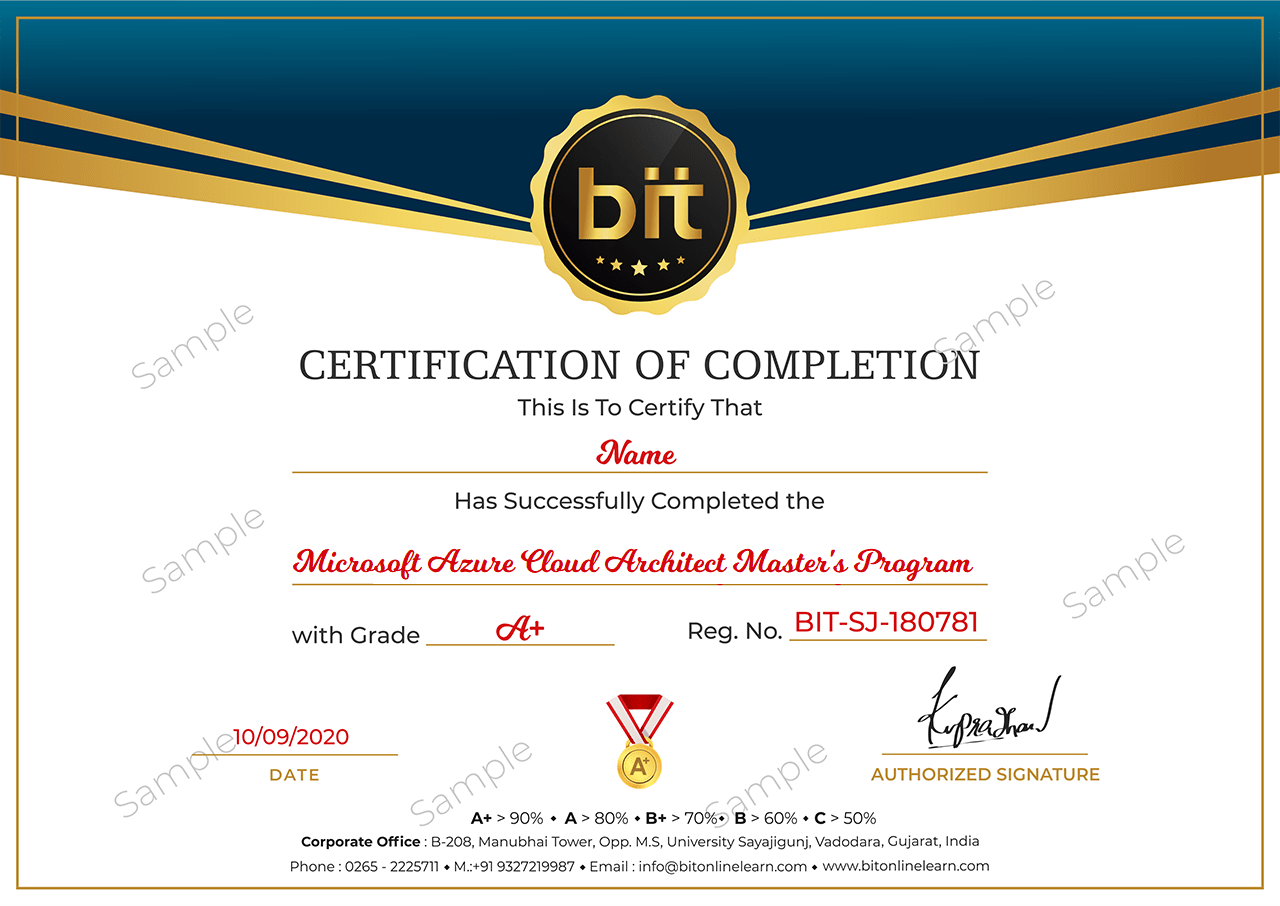
  • Certification & Job Assistance
  • Free Access to Workshop & Webinar
  • No Cost EMI Option


Have Query ?

What you will learn

  • This Azure certification program will make you an expert in Azure applications and architecture.
  • you will understand the main principles of cloud computing and how they have been implemented in Microsoft Azure.
  • Microsoft Azure Fundamentals AZ-900 Training Course will familiarize you with the main principles of cloud computing and...
  • This AZ-204 exam verifies your ability to select, develop, and implement Azure cloud technology solutions.
  • AZ-303: Azure Architect Technologies Exam - You will learn to deploy and configure infrastructure, implement workloads a...
  • AZ-304 Azure Architect Design Exam - You will learn how to determine workload requirements, design for identity and secu...

Requirements

  • Understanding of on-premises virtualization technologies, including: VMs, virtual networking, and virtual hard disks. Understanding of network configuration, including TCP/IP, Domain Name System (DNS), virtual private networks (VPNs), firewalls, and encryption technologies.

Description

|| About Microsoft Azure Cloud Architect Training 

BIT’s Azure Cloud Architect Master’s Online Training Program will help you master the Azure infrastructure by understanding Azure Cloud Architect Technology Solutions, implementing workloads and security in Azure, creating and deploying apps in Azure, and securing data in Azure. Our Microsoft Azure Certification Cloud Architect master's course will help you be a complete Microsoft Azure Architect. You will work on real-world projects in Azure AZ-900, AZ-104, AZ-204, AZ-303, and AZ-304. This Azure certification course includes developing applications for Azure, administrating and architecting Azure infrastructure, and more. As part of this Azure online classroom training, you will also receive official course material issued by Microsoft for Integrating On-premises Identity Infrastructure with Microsoft Azure, Developing Microsoft Azure and Web Services, and Developing Microsoft Azure Solutions.


This Azure certification program will make you an expert in Azure applications and architecture. Through this training, you will understand the main principles of cloud computing and how they have been implemented in Microsoft Azure. Additionally, you will learn how to manage subscriptions, billing, and role-based access control regarding Azure users and groups; implement use cases and configuration options for Azure app services and app service environments; design an Azure app service web app by using Azure CLI, Powershell, and other tools; and manage security and identity for Azure solutions.


This course teaches whole Solutions Architects how to translate business requirements into secure, scalable, and reliable solutions. Lessons include design considerations related to logging, cost analysis, authentication and authorization, governance, security, storage, high availability, and migration. This role requires decisions in multiple areas that affect an overall design solution. This course is for IT Professionals with expertise in designing and implementing solutions running on Microsoft Azure. They should have a broad knowledge of IT operations, including networking, virtualization, identity, security, business continuity, disaster recovery, data platform, budgeting, and governance. Azure Solution Architects use the Azure Portal and as they become more adept they use the Command Line Interface. Candidates must have expert-level skills in Azure administration and have experience with Azure development processes and DevOps processes. Candidates for this exam should have subject matter expertise in designing and implementing solutions that run on Microsoft Azure, including aspects like compute, network, storage, and security. Candidates should have intermediate-level skills for administering Azure. Candidates should understand Azure development and DevOps processes. 


·         Exam:AZ-900 Microsoft Azure Fundamentals          

·         Exam:AZ-104T00-A Microsoft Azure Administrator           

·         Exam AZ-204 Developing Solutions for Microsoft Azure    

·         Exam-AZ-303 Microsoft Azure Architect Technologies       

·         Exam:AZ-304 Microsoft Azure Architect Design

Course Content

Lecture-1 Cloud Concepts

In this Lecture you will learn basic cloud concepts.

·      Lessons

·      Learning Objectives

·      Why Cloud Services?

·      Infrastructure-as-a-Service (IaaS), Platform-as-a-Service (PaaS) and Software-as-aService (SaaS)

·      Public, Private, and Hybrid cloud models

·      After completing this Lecture, students will be able:

·      Understand general cloud computing concepts

Lecture-2 Core Azure Services

In this Lecture you will learn the basics core services available with Microsoft Azure.

·      Lessons

·      Core Azure architectural components

·      Core Azure Services and Products

·      Azure Solutions

·      Azure management tools

·      After completing this Lecture, students will be able:

·      Understand core services available with Microsoft Azure

Lecture-3 Security, Privacy, Compliance and Trust

In this Lecture, you learn about security, privacy, compliance, and trust with Microsoft Azure.

·      Lessons

·      Securing network connectivity in Azure

·      Core Azure Identity services

·      Security tools and features

·      Azure governance methodologies

·      Monitoring and Reporting in Azure

·      Privacy, Compliance and Data Protection standards in Azure

·      After completing this Lecture, students will be able:

·      Understand security, privacy, compliance and trust with Microsoft Azure

Lecture-4 Azure Pricing and Support

In this Lecture, you will focus on pricing and support models available with Microsoft.

·      Lessons

·      Azure subscriptions

·      Planning and managing costs

·      Support options available with Azure

·      Service lifecycle in Azure

·      After completing this Lecture, students will be able:

·      Understand pricing and support models available with Microsoft

Lecture-5 Identity

In this Lecture, you will learn how to secure identities with Azure Active Directory, and implement users and groups.

·      Lessons

·      Azure Active Directory

·      Users and Groups

·      Lab: Manage Azure Active Directory Identities

·      After completing this Lecture, students will be able to:

·      Secure and manage identities with Azure Active Directory.

·      Implement and manage users and groups.

Lecture-6 Governance and Compliance

In this Lecture, you will learn about managing your subscriptions and accounts, implementing Azure policies, and using Role-Based Access Control.

·      Lessons

·      Subscriptions and Accounts

·      Azure Policy

·      Role-based Access Control (RBAC)

·      Lab: Manage Subscriptions and RBAC

·      Lab: Manage Governance via Azure Policy

·      After completing this Lecture, students will be able to:

·      Implement and manage Azure subscriptions and accounts.

·      Implement Azure Policy, including custom policies.

·      Use RBAC to assign permissions.

Lecture-7 Azure Administration

In this Lecture, you will learn about the tools an Azure Administrator uses to manage their infrastructure. This includes the Azure Portal, Cloud Shell, Azure PowerShell, CLI, and Resource Manager Templates. This Lecture includes:

·      Lessons

·      Azure Resource Manager

·      Azure Portal and Cloud Shell

·      Azure PowerShell and CLI

·      ARM Templates

·      Lab: Manage Azure resources by Using the Azure Portal

·      Lab: Manage Azure resources by Using ARM Templates

·      Lab: Manage Azure resources by Using Azure PowerShell

·      Lab: Manage Azure resources by Using Azure CLI

·      After completing this Lecture, students will be able to:

·      Leverage Azure Resource Manager to organize resources.

·      Use the Azure Portal and Cloud Shell.

·      Use Azure PowerShell and CLI.

·      Use ARM Templates to deploy resources.

Lecture-8 Virtual Networking

In this Lecture, you will learn about basic virtual networking concepts like virtual networks and subnetting, IP addressing, network security groups, Azure Firewall, and Azure DNS,

·      Lessons

·      Virtual Networks

·      IP Addressing

·      Network Security groups

·      Azure Firewall

·      Azure DNS

·      Lab: Implement Virtual Networking

·      After completing this Lecture, students will be able to:

·      Implement virtual networks and subnets.

·      Configure public and private IP addressing.

·      Configure network security groups.

·      Configure Azure Firewall.

·      Configure private and public DNS zones.

Lecture-9 Intersite Connectivity

In this Lecture, you will learn about intersite connectivity features including VNet Peering, Virtual Network Gateways, and Site-to-Site Connections

·      Lessons

·      VNet Peering

·      VPN Gateway Connections

·      ExpressRoute and Virtual WAN

·      Lab: Implement Intersite Connectivity

·      After completing this Lecture, students will be able to:

·      Configure VNet Peering.

·      Configure VPN gateways.

·      Choose the appropriate intersite connectivity solution.

Lecture-10 Network Traffic Management

In this Lecture, you will learn about network traffic strategies including network routing and service endpoints, Azure Load Balancer, Azure Application Gateway, and Traffic Manager.

·      Lessons

·      Network Routing and Endpoints

·      Azure Load Balancer

·      Azure Application Gateway

·      Traffic Manager

·      Lab: Implement Traffic Management

·      After completing this Lecture, students will be able to:

·      Configure network routing including custom routes and service endpoints.

·      Configure an Azure Load Balancer.

·      Configure and Azure Application Gateway.

·      Choose the appropriate network traffic solution.

Lecture-11 Azure Storage

In this Lecture, you will learn about basic storage features including storage accounts, blob storage, Azure files and File Sync, storage security, and storage tools.

·      Lessons

·      Storage Accounts

·      Blob Storage

·      Storage Security

·      Azure Files and File Sync

·      Managing Storage

·      Lab: Manage Azure storage

·      After completing this Lecture, students will be able to:

·      Create Azure storage accounts.

·      Configure blob containers.

·      Secure Azure storage.

·      Configure Azure files shares and file sync.

·      Manage storage with tools such as Storage Explorer.

Lecture-12 Azure Virtual Machines

In this Lecture, you will learn about Azure virtual machines including planning, creating, availability and extensions.

·      Lessons

·      Virtual Machine Planning

·      Creating Virtual Machines

·      Virtual Machine Availability

·      Virtual Machine Extensions

·      Lab: Manage virtual machines

·      After completing this Lecture, students will be able to:

·      Plan for virtual machine implementations.

·      Create virtual machines.

·      Configure virtual machine availability, including scale sets.

·      Use virtual machine extensions.

Lecture-13 Serverless Computing

In this Lecture, you will learn administer serverless computing features like Azure App Service, Azure Container Instances, and Kubernetes.

·      Lessons

·      Azure App Service Plans

·      Azure App Service

·      Container Services

·      Azure Kubernetes Service

·      Lab: Implement Web Apps

·      Lab: Implement Azure Container Instances

·      Lab : Implement Azure Kubernetes Service

·      After completing this Lecture, students will be able to:

·      Create an app service plan.

·      Create a web app.

·      Implement Azure Container Instances.

·      Implement Azure Kubernetes Service

Lecture-14 Data Protection

In this Lecture, you will learn about backing up files and folders, and virtual machine backups.

·      Lessons

·      File and Folder Backups

·      Virtual Machine Backups

·      Lab: Implement Data Protection

·      After completing this Lecture, students will be able to:

·      Backup and restore file and folders.

·      Backup and restore virtual machines

Lecture-15 Monitoring

In this Lecture, you will learn about monitoring your Azure infrastructure including Azure Monitor, alerting, and log analytics.

·      Lessons

·      Azure Monitor

·      Azure Alerts

·      Log Analytics

·      Network Watcher

·      Lab: Implement Monitoring

·      After completing this Lecture, students will be able to:

·      Use Azure Monitor.

·      Create Azure alerts.

·      Query using Log Analytics.

·      Use Network Watcher.

Lecture-16 Creating Azure App Service Web Apps

Students will learn how to build a web application on the Azure App Service platform. They will learn how the platform functions and how to create, configure, scale, secure, and deploy to the App Service platform.

·      Lessons

·      Azure App Service core concepts

·      Creating an Azure App Service Web App

·      Configuring and Monitoring App Service apps

·      Scaling App Service apps

·      Azure App Service staging environments

Lecture-17 Implement Azure functions

This Lecture covers creating Functions apps, and how to integrate triggers and inputs/outputs in to the app.

·      Lessons

·      Azure Functions overview

·      Developing Azure Functions

·      Implement Durable Functions

Lecture-18 Develop solutions that use blob storage

Students will learn how Azure Blob storage works, how to manage data through the hot/cold/archive blob storage lifecycle, and how to use the Azure Blob storage client library to manage data and metadata.

·      Lessons

·      Azure Blob storage core concepts

·      Managing the Azure Blob storage lifecycle

·      Working with Azure Blob storage

Lecture-19 Develop solutions that use Cosmos DB storage

Students will learn how Cosmos DB is structured and how data consistency is managed. Students will also learn how to create Cosmos DB accounts and create databases, containers, and items by using a mix of the Azure Portal and the .NET SDK.

·      Lessons

·      Azure Cosmos DB overview

·      Azure Cosmos DB data structure

·      Working with Azure Cosmos DB resources and data

Lecture-20 Implement IaaS solutions

This Lecture instructs students on how to use create VMs and container images to use in their solutions. It covers creating VMs, using ARM templates to automate resource deployment, create and manage Docker images, publishing an image to the Azure Container Registry, and running a container in Azure Container Instances.

·      Lessons

·      Provisioning VMs in Azure

·      Create and deploy ARM templates

·      Create container images for solutions

·      Publish a container image to Azure Container Registry

·      Create and run container images in Azure Container Instances

Lecture-21 Implement user authentication and authorization

Students will learn how to leverage the Microsoft Identity Platform v2.0 to manage authentication and access to resources. Students will also learn how to use the Microsoft Authentication Library and Microsoft Graph to authenticate a user and retrieve information stored in Azure, and how and when to use Shared Access Signatures.

·      Lessons

·      Microsoft Identity Platform v2.0

·      Authentication using the Microsoft Authentication Library

·      Using Microsoft Graph

·      Authorizing data operations in Azure Storage

Lecture-22 Implement secure cloud solutions

This Lecture covers how to secure the information (keys, secrets, certificates) an application uses to access resources. It also covers securing application configuration information.

·      Lessons

·      Manage keys, secrets, and certificates by using the KeyVault API

·      Implement Managed Identities for Azure resources

·      Secure app configuration data by using Azure App Configuration

Lecture-23 Implement API Management

Students will learn how to publish APIs, create policies to manage information shared through the API, and to manage access to their APIs by using the Azure API Management service.

·      Lessons

·      API Management overview

·      Defining policies for APIs

·      Securing your APIs

Lecture-24 Develop App Service Logic Apps

This Lecture teaches students how to use Azure Logic Apps to schedule, automate, and orchestrate tasks, business processes, workflows, and services across enterprises or organizations.

·      Lessons

·      Azure Logic Apps overview

·      Creating custom connectors for Logic Apps

Lecture-25 Develop event-based solutions

Students will learn how to build applications with event-based architectures.

·      Lessons

·      Implement solutions that use Azure Event Grid

·      Implement solutions that use Azure Event Hubs

·      Implement solutions that use Azure Notification Hubs

Lecture-26 Develop message-based solutions

Students will learn how to build applications with message-based architectures.

·      Lessons

·      Implement solutions that use Azure Service Bus

·      Implement solutions that use Azure Queue Storage queues

Lecture-27 Monitor and optimize Azure solutions

This Lecture teaches students how to instrument their code for telemetry and how to analyze and troubleshoot their apps.

·      Lessons

·      Overview of monitoring in Azure

·      Instrument an app for monitoring

·      Analyzing and troubleshooting apps

·      Implement code that handles transient faults

Lecture-28 Integrate caching and content delivery within solutions

Students will learn how to use different caching services to improve the performance of their apps.

·      Lessons

·      Develop for Azure Cache for Redis

·      Develop for storage on CDNs

Lecture-29 Implement VMs for Windows and Linux

In this Lecture, you will learn about Azure virtual machines including planning, creating, availability and extensions. This Lecture includes:

·      Lessons

·      Select Virtual Machine Size

·      Configure High Availability

·      Implement Azure Dedicated Hosts

·      Deploy and Configure Scale Sets

·      Configure Azure Disk Encryption

·      After completing this Lecture, students will be able to:

·      Plan for virtual machine implementations.

·      Create virtual machines.

·      Configure virtual machine availability, including scale sets.

·      Understand High Availability options for VMs in Azure

Lecture-30 Automate Deployment and Configuration of Resources

In this Lecture, you will learn about the tools an Azure Administrator uses to manage their infrastructure. This includes the Azure Portal, Cloud Shell, Azure PowerShell, CLI, and Resource Manager Templates. This Lecture includes:

·      Lessons

·      Azure Resource Manager Templates

·      Save a Template for a VM

·      Evaluate Location of New Resources

·      Configure a Virtual Hard Disk Template

·      Deploy from a Template

·      Create and Execute an Automation Runbook

·      After completing this Lecture, students will be able to:

·      Leverage Azure Resource Manager to organize resources.

·      Use ARM Templates to deploy resources.

·      Create and Execute an Automation Runbook

·      Deploy an Azure VM from a VHD

·      Understand Azure encryption technologies

Lecture-31 Implement Virtual Networking

In this Lecture, you will learn about basic virtual networking concepts like virtual networks and subnetting, IP addressing, network security groups, Azure Firewall, and Azure DNS.

·      Lessons

·      Virtual Network Peering

·      Implement VNet Peering

·      After completing this Lecture, students will be able to:

·      Connect services with Virtual Network Peering

·      Configure VNet Peering

·      Understand Service Chaining

·      Modify or delete VNet Peering

Lecture-32 Implement Load Balancing and Network Security

In this Lecture, you will learn about network traffic strategies including network routing and service endpoints, Azure Load Balancer, Azure Application Gateway, and Traffic Manager.

·      Lessons

·      Implement Azure Load Balancer

·      Implement an Application Gateway

·      Understand Web Application Firewall

·      Implement Azure Firewall

·      Implement Azure Front Door

·      Implementing Azure Traffic Manager

·      Implement Network Security Groups and Application Security Ground

·      Implement Azure Bastion

·      After completing this Lecture, students will be able to:

·      Select a Load Balancer solution

·      Configure Application Gateway

·      Implement Azure Firewall

·      Create an Azure Front Door

·      Understand Traffic Manager routing methods

·      Configure Network Security Groups (NSGs)

Lecture-33 Implement Storage Accounts

In this Lecture, you will learn about basic storage features including storage accounts, blob storage, Azure files and File Sync, storage security, and storage tools.

·      Lessons

·      Storage Accounts

·      Blob Storage

·      Storage Security

·      Managing Storage

·      Accessing Blobs and Queues using AAD

·      Configure Azure Storage Firewalls and Virtual Networks

·      After completing this Lecture, students will be able to:

·      Understand Storage Account services and types

·      Configure Blob storage, accounts, containers, and access tiers

·      Implement Shared Access Signatures

·      Understand Azure Storage firewalls and virtual networks

Lecture-34 Implement Azure Active Directory

In this Lecture, you will learn how to secure identities with Azure Active Directory, and implement users and groups.

·      Lessons

·      Overview of Azure Active Directory

·      Users and Groups

·      Domains and Custom Domains

·      Azure AD Identity Protection

·      Implement Conditional Access

·      Configure Fraud Alerts for MFA

·      Implement Bypass Options

·      Configure Trusted IPs

·      Configure Guest Users in Azure AD

·      Manage Multiple Directory

·      After completing this Lecture, students will be able to:

·      Understand how Multiple AAD organizations interact

·      Add Guest Users to Azure AD

·      Configure Location Condition Configuration

·      Configure Azure MFA settings

·      Implement Conditional Access Azure MFA

Lecture-35 Implement and Manage Azure Governance

In this Lecture, you will learn about managing your subscriptions and accounts, implementing Azure policies, and using Role-Based Access Control.

·      Lessons

·      Create Management Groups, Subscriptions, and Resource Groups

·      Overview of Role-Based Access Control (RBAC)

·      Role-Based Access Control (RBAC) Roles

·      Azure AD Access Reviews

·      Implement and Configure an Azure Policy

·      Azure Blueprints

·      After completing this Lecture, students will be able to:

·      Understand Resource Group 0rganization

·      Understand how RBAC works

·      Create an Azure AD access review

·      Create and manage policies to enforce compliance

·      Create a Blueprint

Lecture-36 Implement and Manage Hybrid Identities

In this Lecture, you will learn how to install and configure Azure AD Connect and implement Azure AD Connect Health.

·      Lessons

·      Install and Configure Azure AD Connect

·      Configure Password Sync and Password Writeback

·      Configure Azure AD Connect Health

·      After completing this Lecture, students will be able to:

·      Implement Azure AD seamless Single Sign-On

·      Perform an Azure AD Connect installation

·      Implement Azure AD Connect Health

Lecture-37 Manage Workloads in Azure

In this Lecture, you will learn how to migrate workloads using Azure Migrate, perform VMware agent-based and agent-less migrations, and perform Azure Backup and Azure Site Recovery.

·      Lessons

·      Migrate Workloads using Azure Migrate

·      VMware - Agentless Migration

·      VMware - Agent-Based Migration

·      Implement Azure Backup

·      Azure to Azure Site Recovery

·      Implement Azure Update Management

·      After completing this Lecture, students will be able to:

·      Understand agent-based migration architecture

·      Prepare for Azure for migration

·      Prepare an on-premises VMware environment

·      Understand Azure VM backup architecture

·      Manage updates and patches for Azure VMs

Lecture-38 Implement Cloud Infrastructure Monitoring

In this Lecture, you will learn about Azure Monitor, Azure Workbooks, Azure Alerts, Network Watcher, Azure Service Health, Azure Application Insights.

·      Lessons

·      Azure Infrastructure Security Monitoring

·      Azure Monitor

·      Azure Workbooks

·      Azure Alerts

·      Log Analytics

·      Network Watcher

·      Azure Service Health

·      Monitor Azure Costs

·      Azure Application Insights

·      Unified Monitoring in Azure

Lecture-39 Manage Security for Applications

In this Lecture, you will learn about Azure Key Vault and implementing authentication using Azure Managed Identities.

·      Lessons

·      Azure Key Vault

·      Azure Managed Identity

·      After completing this Lecture, students will be able to:

·      Explain Key Vault uses such as secrets, key, and Certificates management

·      Use Managed Identities with Azure resources

Lecture-40 Implement an Application Infrastructure

In this Lecture, you will learn how to create an App Service web App for Containers, create and configure an App Service Plan, and create and manage Deployment Slots.

·      Lessons

·      Create and Configure Azure App Service

·      Create an App Service Web App for Containers

·      Create and Configure an App Service Plan

·      Configure Networking for an App Service

·      Create and Manage Deployment Slots

·      Implement Logic Apps

·      Implement Azure Functions

·      After completing this Lecture, students will be able to:

·      Configure an Azure App Service

·      Create an App Service Plan

·      Create a Workflow using Azure Logic Apps

·      Create a Function App

Lecture-41 Implement Container-Based Applications

In this Lecture, you will learn how to run Azure Container instances and how to deploy Kubernetes with AKS.

·      Lessons

·      Azure Container Instances

·      Configure Azure Kubernetes Service

·      After completing this Lecture, students will be able to:

·      Run Azure Container instances

·      Deploy Kubernetes with AKS

Lecture-42 Implement NoSQL Databases

In this Lecture, you will learn about Azure Table Storage and recommend options for CosmsoDB APIs.

·      Lessons

·      Configure Storage Account Tables

·      Select Appropriate CosmosDB APIs

·      After completing this Lecture, students will be able to:

·      Outline the Table Service Data Model

·      Understand options for Azure Cosmos DB

·      Understand high availability using CosmosDB

Lecture-43 Implement Azure SQL Databases

In this Lecture, you will create an Azure SQL Database single database, create an Azure SQL Database Managed Instance, and review high-availability and Azure SQL database.

·      Lessons

·      Configure Azure SQL Database Settings

·      Implement Azure SQL Database Managed Instances

·      High-Availability and Azure SQL Database

·      After completing this Lecture, students will be able to:

·      Create an Azure SQL Database single database

·      Create an Azure SQL Database Managed Instance

·      Recommend high-availability architectural models used in Azure SQL Database