
Data Analytics Using Power BI Course

BIT's Data Analytics Using Power BI online training course lets you master the Power BI tool in Data Analytics.

  • 45000
  • 50000
  • Course Includes
  • Live Class Practical Oriented Training
  • 70 + Hrs Instructor LED Training
  • 45 + Hrs Practical Exercise
  • 25 + Hrs Project Work & Assignment
  • Timely Doubt Resolution
  • Dedicated Student Success Mentor
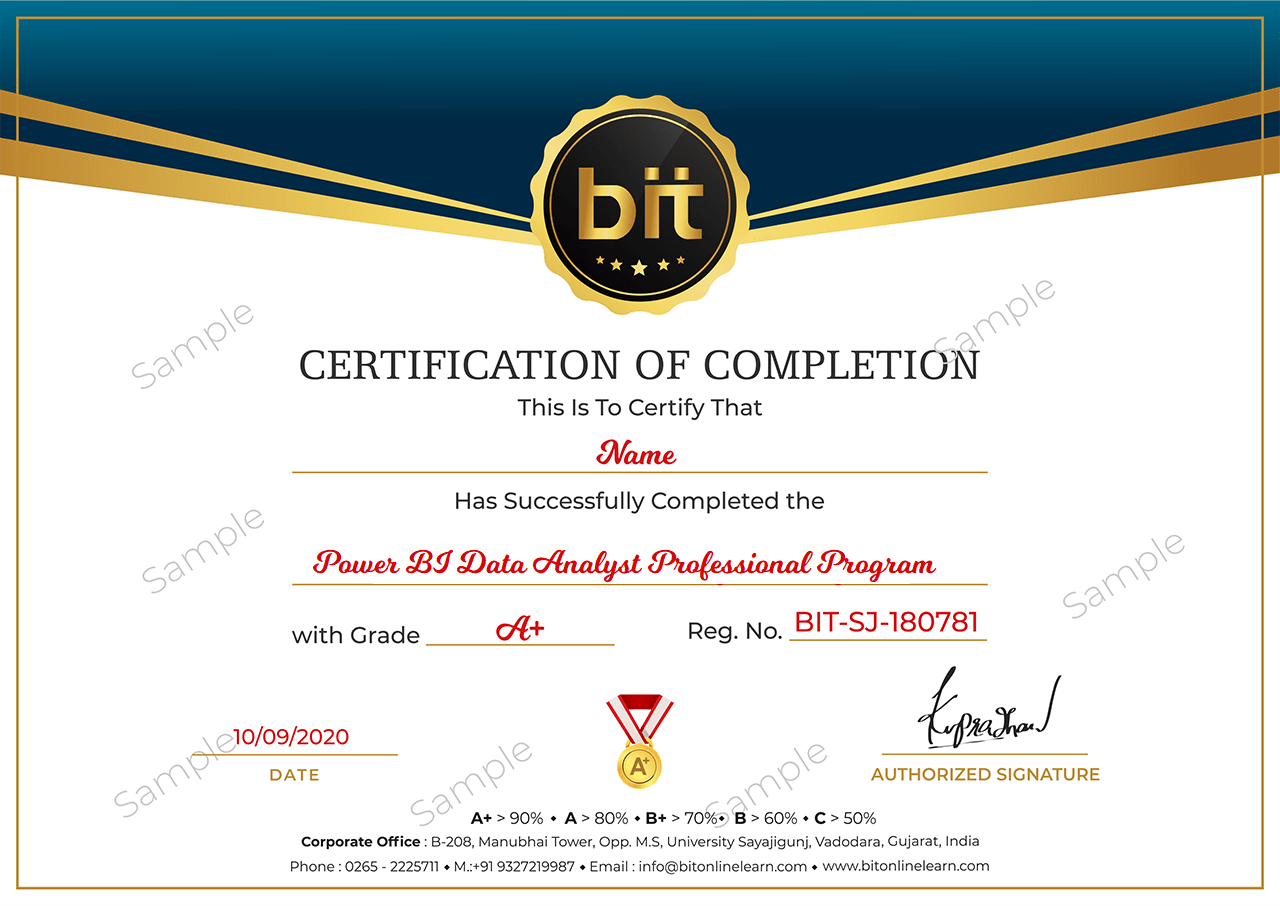
  • Certification & Job Assistance
  • Free Access to Workshop & Webinar
  • No Cost EMI Option


Have Query ?

What you will learn

  • Ingest, clean, and transform data
  • Model data for performance and scalability
  • Design and create reports for data analysis
  • Apply and perform advanced report analytics
  • Manage and share report assets
  • Create paginated reports in Power BI

Requirements

  • Understanding core data concepts. Knowledge of working with relational data in the cloud. Knowledge of working with non-relational data in the cloud. Knowledge of data analysis and visualization concepts.

Description

|| About Data Analytics using Power BI Training Course

Data Analytics using Power BI online training will discuss the various methods and best practices that are in line with business and technical requirements for modeling, visualizing, and analyzing data with Power BI. The course will also show how to access and process data from a range of data sources including both relational and non-relational data. This course will also explore how to implement proper security standards and policies across the Power BI spectrum including datasets and groups. The course will also discuss how to manage and deploy reports and dashboards for sharing and content distribution. Finally, this course will show how to build paginated reports within the Power BI service and publish them to a workspace for inclusion within Power BI.


This course is designed for data professionals and business intelligence professionals who want to learn how to accurately perform data analysis using Power BI. This course is also targeted toward those individuals who develop reports that visualize data from the data platform technologies that exist on both in the cloud and on-premises. Data Analysts enable businesses to maximize the value of their data assets by using Microsoft Power BI. As a subject matter expert, Data Analysts are responsible for designing and building scalable data models, cleaning and transforming data, and enabling advanced analytic capabilities that provide meaningful business value through easy-to-comprehend data visualizations. Data Analysts also collaborate with key stakeholders across verticals to deliver relevant insights based on identified business requirements. The Data Analyst should have a fundamental understanding of data repositories and data processing both on-premises and in the cloud.


Course Content

Live Lecture

This Lecture explores the different roles in the data space, outlines the important roles and responsibilities of a Data Analysts, and then explores the landscape of the Power BI portfolio.

·      Lessons

·      Data Analytics and Microsoft

·      Getting Started with Power BI

·      Lab : Getting Started

·      Getting Started

·      After completing this Lecture, you will be able to:

·      Explore the different roles in data

·      Identify the tasks that are performed by a data analyst

·      Describe the Power BI landscape of products and services

·      Use the Power BI service              
Live Lecture

This Lecture explores identifying and retrieving data from various data sources. You will also learn the options for connectivity and data storage, and understand the difference and performance implications of connecting directly to data vs. importing it.

·      Lessons

·      Get data from various data sources

·      Optimize performance

·      Resolve data errors

·      Lab : Preparing Data in Power BI Desktop

·      Prepare Data

·      After completing this Lecture, you will be able to:

·      Identify and retrieve data from different data sources

·      Understand the connection methods and their performance implications

·      Optimize query performance

·      Resolve data import errors            

Live Lecture

This Lecture teaches you the process of profiling and understanding the condition of the data. They will learn how to identify anomalies, look at the size and shape of their data, and perform the proper data cleaning and transforming steps to prepare the data for loading into the model.

·      Lessons

·      Data shaping

·      Enhance the data structure

·      Data Profiling

·      Lab : Transforming and Loading Data

·      Loading Data

·      After completing this Lecture, students will be able to:

·      Apply data shape transformations

·      Enhance the structure of the data

·      Profile and examine the data                    

Live Lecture

This Lecture teaches the fundamental concepts of designing and developing a data model for proper performance and scalability. This Lecture will also help you understand and tackle many of the common data modeling issues, including relationships, security, and performance.

·      Lessons

·      Introduction to data modeling

·      Working with tables

·      Dimensions and Hierarchies

·      Lab : Data Modeling in Power BI Desktop

·      Create Model Relationships

·      Configure Tables

·      Review the model interface

·      Create Quick Measures

·      Lab : Advanced Data Modeling in Power BI Desktop

·      Configure many-to-many relationships

·      Enforce row-level security

·      After completing this Lecture, you will be able to:

·      Understand the basics of data modeling

·      Define relationships and their cardinality

·      Implement Dimensions and Hierarchies

·      Create histograms and rankings