Data Science Master's Program

BIT's Data Science Masters Program online training course makes you proficient in tools and systems used by Data Science Professionals. It includes training on Statistics, Data Science, Python, Apache Spark & Scala, SAS and Tableau etc.

  • 170000
  • 200000
  • Course Includes
  • Live Class Practical Oriented Training
  • 200 + Hrs Instructor LED Training
  • 150 + Hrs Practical Exercise
  • 100 + Hrs Project Work & Assignment
  • Timely Doubt Resolution
  • Dedicated Student Success Mentor
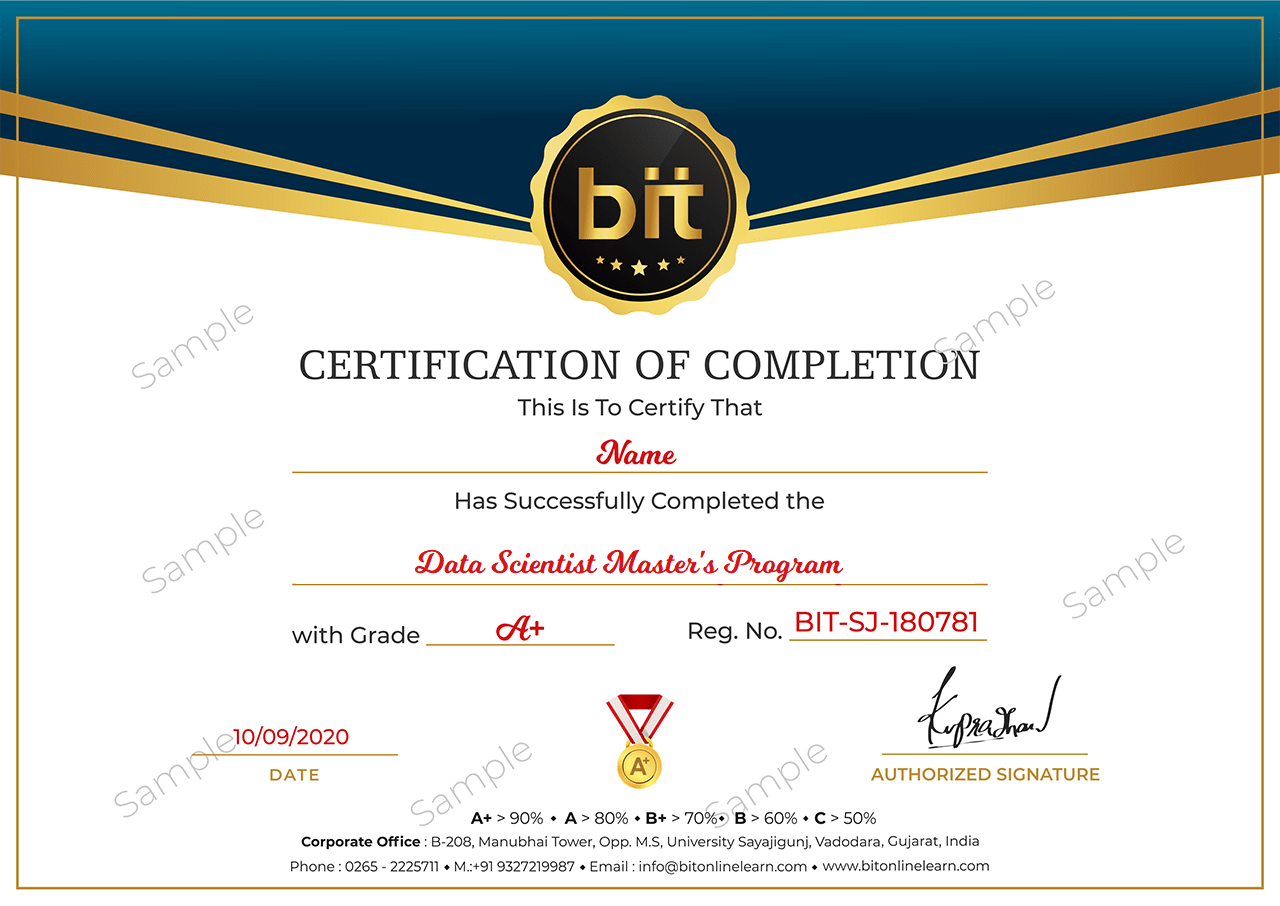
  • Certification & Job Assistance
  • Free Access to Workshop & Webinar
  • No Cost EMI Option


Have Query ?

What you will learn

  • Learn the data science process, including how to build effective data visualizations, and how to communicate with variou...
  • Develop software engineering skills that are essential for data scientists, such as creating unit tests and building cla...
  • Learn to work with data through the entire data science process, from running pipelines, transforming data, building mod...
  • Learn to design experiments and analyze results. Explore approaches for building recommendation systems.
  • Leverage what you’ve learned throughout the program to build your own open-ended Data Science project. This project will...
  • MapReduce and HDFS. Real-time analytics with Spark. Data Scientist roles and responsibilities. Prediction and analysis t...
  • Deploying the recommender system. SAS advanced analytics and R programming. Linear and logistic regression
  • Making sense of NoSQL data. Deep Learning model in AI

Requirements

  • Basic understanding of Computer Programming Languages.

Description

|| About Data Sceince Master's Program Course

BIT’s Data Science Master’s Program online training course lets you gain proficiency in Data Science. Data Science with Python, R, Hadoop Dev, Admin, Test and Analysis, Apache Spark, Scala, Deep Learning, Tableau, Data Science with SAS, SQL, MongoDB and more. You’ll master the skills necessary to become a successful Data Scientist. You’ll work on projects designed by industry experts, and learn to run data pipelines, design experiments, build recommendation systems, and deploy solutions to the cloud.


Masters Program is a structured learning path recommended by leading industry experts and ensures that you transform into Data Scientist. This immersive Data Scientist program starts with Data Science training to master important Data Extraction, Exploration Techniques, and Machine Learning Algorithms, then helps you gain expertise on Python for dealing with Big Data, followed by becoming adept at Apache Spark and it's machine learning capabilities and become proficient in trending skills about AI & Deep learning using Tensorflow and finally ends at Data Visualization using Tableau. Data Scientist Masters Program has been curated after thorough research and recommendations from industry experts. It will help you master concepts of Data Management, Statistics, Machine Learning and Big Data together with hands-on experience of tools & systems used by Data Scientists including Data Visualisation using Tableau.


Course Content

Introduction Data Science

Interested in learning more about data science, but don’t know where to start? This course will provide you with the key foundational skills any data scientist needs to prepare you for a career in data science or further advanced learning in the field.


This Specialization will introduce you to what data science is and what data scientists do. You’ll discover the applicability of data science across fields, and learn how data analysis can help you make data driven decisions. You’ll find that you can kickstart your career path in the field without prior knowledge of computer science or programming languages: this Specialization will give you the foundation you need for more advanced learning to support your career goals.


You’ll grasp concepts like big data, statistical analysis, and relational databases, and gain familiarity with various open source tools and data science programs used by data scientists, like Jupyter Notebooks, RStudio, GitHub, and SQL. You'll complete hands-on labs and projects to learn the methodology involved in tackling data science problems and apply your newly acquired skills and knowledge to real world data sets.


Topics Includes: 

Part 1 Advance Excel

Part 2 Statistics & Probability

Part 3 Data Science with Python

Part 4 Data Science with R

Part 5 Data Science with SAS

Part 6 Deep Learning & Artificial Intelligence

Part 7 Mongo DB

Part 8 MS SQL

Part 9 Big Data Hadoop & Spark

Part 10 Tableau

Lectutre-1 Entering Data

·      Introduction to Excel spreadsheet

·      Learning to enter data

·      Flling of series and custom fill list

·      Editing and deleting field

·      Practical Exercise              


Lecture-2 Referencing in Formulas

·      Learning about relative and absolute referencing

·      The concept of relative formulae

·      The issues in relative formulae

·      Creating of absolute and mixed references

·      Practical Exercise              

Lecture-3 Name Range

·      Creating names range

·      Using names in new formulae

·      Working with the name box

·      Selecting range

·      Names from a selection

·      Pasting names in formulae

·      Selecting names

·      Working with Name Manager

·      Practical Exercise              

Lecture-4 Understanding Logical Functions

·      The various logical functions in Excel

·      The If function for calculating values and displaying text

·      Nested If functions

·      VLookUp and IFError functions

·      Practical Exercise              

Lecture-5 Getting started with Conditional Formatting

·      Learning about conditional formatting

·      The options for formatting cells

·      Various operations with icon sets

·      Data bars and color scales

·      Creating and modifying sparklines

·      Practical Exercise              

Lecture-6 Advanced-level Validation

·      Multi-level drop down validation

·      Restricting value from list only

·      Learning about error messages and cell drop down

·      Practical Exercise              

Lecture-7 Important Formulas in Excel

·      Introduction to the various formulae in Excel

·      Sum, SumIF & SumIFs

·      Count, CountA, CountIF and CountBlank

·      Networkdays, Networkdays International

·      Today & Now function

·      Trim (Eliminating undesirable spaces)

·      Concatenate (Consolidating columns)

·      Practical Exercise              

Lecture-8 Working with Dynamic table

·      Introduction to dynamic table in Excel

·      Data conversion

·      Table conversion

·      Tables for charts

·      VLOOKUP

·      Practical Exercise              

Lecture-9 Data Sorting

·      Sorting in Excel

·      Various types of sorting

·      Alphabetical

·      Numerical

·      Row

·      Multiple column

·      Working with paste special

·      Hyperlinking

·      Using subtotal

·      Practical Exercise              

Lecture-10 Data Filtering

·      The concept of data filtering

·      Understanding compound filter and its creation

·      Removing of filter

·      Using custom filter and multiple value filters

·      Working with wildcards

·      Practical Exercise              

Lecture-11 Chart Creation

·      Creation of Charts in Excel

·      Performing operations in embedded chart

·      Modifying

·      Resizing

·      Dragging of chart

·      Practical Exercise              

Lecture-12 Various Techniques of Charting

·      Introduction to the various types of charting techniques

·      Creating titles for charts

·      Axes

·      Learning about data labels

·      Displaying data tables

·      Modifying axes

·      Displaying gridlines and inserting trendlines

·      Textbox insertion in a chart

·      Creating a 2-axis chart

·      Creating combination chart

·      Practical Exercise              

Lecture-13 Pivot Tables in Excel

·      The concept of Pivot tables in Excel

·      Report filtering

·      Shell creation

·      Working with Pivot for calculations

·      Formatting of reports

·      Dynamic range assigning

·      The slicers

·      Creating of slicers

·      Practical Exercise              

Lecture-14 Ensuring Data and File Security

·      Data and file security in Excel

·      Protecting row, column, and cell

·      Different safeguarding techniques

·      Practical Exercise              

Lecture-15 Getting started with VBA Macros

·      Learning about VBA macros in Excel

·      Executing macros in Excel

·      The macro shortcuts

·      Applications

·      The concept of relative reference in macros

·      Practical Exercise              

Lecture-16 Core concepts of VBA

·      In-depth understanding of Visual Basic for Applications

·      The VBA Editor

·      Module insertion and deletion

·      Performing action with Sub

·      Ending Sub if condition not met

·      Practical Exercise              

Lecture-17 Ranges and Worksheet in VBA

·      Learning about the concepts of workbooks & worksheets in Excel Protection of macro codes

·      Range coding

·      Declaring a variable

·      The concept of Pivot Table in VBA

·      Introduction to arrays

·      User forms

·      Getting to know how to work with databases within Excel

·      Practical Exercise              

Lecture-18 IF condition

·      Learning how the If condition works

·      How to apply it in various scenarios

·      Working with multiple Ifs in Macro

·      Practical Exercise              

Lecture-19 Loops in VBA

·      Understanding the concept of looping

·      Deploying looping in VBA Macros

·      Practical Exercise              

Lecture-20 Debugging in VBA

·      Studying about debugging in VBA

·      The various steps of debugging

·      Understanding breakpoints and way to mark it

·      The code for debugging and code commenting

·      Practical Exercise              

Lecture-21 Messaging in VBA

·      The concept of message box in VBA

·      Learning to create the message box

·      Various types of message boxes

·      The IF condition as related to message boxes

·      Practical Exercise              

Lecture-22 Practical Projects in VBA

·      Mastering the various tasks and functions using VBA

·      Understanding data separation

·      Auto filtering

·      Formatting of report

·      Combining multiple sheets into one

·      Merging multiple files together

·      Practical Exercise              

Lecture-23 Best Practices of Dashboards Visualization

·      Introduction to powerful data visualization with Excel Dashboard

·      Loading the data

·      Managing data and linking the data to tables and charts

·      Creating Reports using dashboard features

·      Practical Exercise              

Lecture-24 Principles of Charting

·      Learning to create charts in Excel

·      The various charts available

·      The steps to successfully build a chart

·      Personalization of charts

·      Formatting and updating features

·      Various special charts for Excel dashboards

·      Understanding how to choose the right chart for the right data

·      Practical Exercise              

Lecture-25 Getting started with Pivot Tables

·      Creation of Pivot Tables in Excel

·      Learning to change the Pivot Table layout

·      Generating Reports

·      The methodology of grouping and ungrouping of data

·      Practical Exercise              

Lecture-26 Creating Dashboards

·      Learning to create Dashboards

·      The various rules to follow while creating Dashboards

·      Creation of dynamic dashboards

·      Knowing what is data layout

·      Introduction to thermometer chart and its creation

·      How to use alerts in the Dashboard setup

·      Practical Exercise              

Lecture-27 Creation of Interactive Components

·      How to insert a Scroll bar to a data window

·      Concept of Option buttons in a chart

·      Use of combo box drop-down

·      List box control Usage

·      How to use Checkbox Control

·      Practical Exercise              

Lecture-28 Data Analysis

·      Understanding data quality issues in Excel

·      Linking of data

·      Consolidating and merging data

·      Working with dashboards for Excel Pivot Tables

·      Practical Exercise              

Lecture -1 Information of Statistics

·      What is statistics?

·      How is this useful

·      What is this course for

·      Practical Exercise              

Lecture -2 Data Conversion

·      Converting data into useful information

·      Collecting the data

·      Understand the data

·      Finding useful information in the data

·      Interpreting the data

·      Visualizing the data

·      Practical Exercise              

Lecture -3 Terms of Statistics

·      Descriptive statistics

·      Let us understand some terms in statistics

·      Variable

·      Practical Exercise              

Lecture -4 Plots

·      Dot Plots

·      Histogram

·      Stemplots

·      Box and whisker plots

·      Outlier detection from box plots and Box and whisker plots

·      Practical Exercise              

Lecture -5 Statistics & Probability

·      What is probability?

·      Set & rules of probability

·      Bayes Theorem

·      Practical Exercise              

Lecture -6 Distributions

·      Probability Distributions

·      Few Examples

·      Student T- Distribution

·      Sampling Distribution

·      Student t- Distribution

·      Poison distribution

·      Practical Exercise              

Lecture -7 Sampling

·      Stratified Sampling

·      Proportionate Sampling

·      Systematic Sampling

·      P – Value

·      Stratified Sampling

·      Practical Exercise              

Lecture -8 Tables & Analysis

·      Cross Tables

·      Bivariate Analysis

·      Multi variate Analysis

·      Dependence and Independence tests ( Chi-Square )

·      Analysis of Variance

·      Correlation between Nominal variables

·      Practical Exercise              

Lecture 1-22 Python Programming

·      Python Environment Setup and Essentials

·      The Installation of Anaconda Python Distribution

·      What Is A Programming Language

·      Python Interpreter

·      How To Run Python Code

·      Our First Python Program

·      Learning Python

·      Python Data Types

·      Numbers

·      Math Functions

·      Operator Precedence

·      Optional: bin() and complex

·      Variables

·      Expressions vs Statements

·      Augmented Assignment Operator

·      Strings

·      String Concatenation

·      Type Conversion

·      Escape Sequences

·      Formatted Strings

·      String Indexes

·      Immutability

·      Built-In Functions + Methods

·      Booleans

·      Lists

·      List Slicing

·      Matrix

·      List Methods

·      Common List Patterns

·      List Unpacking

·      Dictionaries

·      Practical Exercise              

Lecture 23-24 Pandas

·      Pandas Introduction

·      Series, Data Frames and CSVs

·      Data from URLs

·      Describing Data with Pandas

·      Selecting and Viewing Data with Pandas

·      Manipulating Data

·      Practical Exercise              

Lecture 25-27 NumPy

·      Mathematical Computing with Python (NumPy)

·      NumPy Introduction

·      NumPy DataTypes and Attributes

·      Creating NumPy Arrays

·      NumPy Random Seed

·      Viewing Arrays and Matrices

·      Manipulating Arrays

·      Standard Deviation and Variance

·      Reshape and Transpose

·      Dot Product vs Element Wise

·      Store Sales

·      Comparison Operators

·      Sorting Arrays

·      Turn Images Into NumPy Arrays

·      Practical Exercise              

Lecture-28 Introduction to Machine Learning

·      What Is Machine Learning?

·      AI/Machine Learning/Data Science

·      Practical Exercise              

Lecture 29-30 Machine Learning and Data Science Framework

·      Machine Learning Framework

·      Types of Machine Learning

·      Types of Data

·      Types of Evaluation

·      Features In Data

·      Modelling - Splitting Data

·      Modelling - Picking the Model

·      Modelling - Tuning

·      Modelling – Comparison

·      Practical Exercise              

Lecture-31 Data Science Environment Setup

·      Introducing Our Tools

·      Windows Environment Setup

·      Linux Environment Setup

·      Jupyter Notebook Walkthrough

·      Practical Exercise              

Lecture 32-35 Matplotlib + Seaborn: Plotting and Data Visualization

·      Matplotlib Introduction

·      Importing And Using Matplotlib

·      Anatomy Of A Matplotlib Figure

·      Scatter Plot And Bar Plot

·      Histograms And Subplots

·      Subplots Option 2

·      Plotting From Pandas DataFrames

·      Customizing Your Plots

·      Saving And Sharing Your Plots

·      Practical Exercise              

Lecture 36-40 Scikit-learn: Creating Machine Learning Models

·      Scikit-learn Introduction

·      Scikit-learn Cheatsheet

·      Typical scikit-learn Workflow

·      Debugging Warnings In Jupyter

·      Splitting Your Data

·      Clean, Transform, Reduce

·      Convert Data To Numbers

·      Handling Missing Values With Pandas

·      Handling Missing Values With Scikit-learn

·      Choosing The Right Model For Your Data

·      Practical Exercise              

Lecture 41-45 Scikit-learn - Regression Model

·      Types of Regression Algorithms

·      Simple Linear Regression

·      Multiple Linear Regression

·      Logistic Regression

·      Polynomial Regression

·      Support Vector Regression

·      Ridge Regression

·      Lasso Regression

·      ElasticNet Regression

·      Bayesian Regression

·      Decision Tree Regression

·      Random Forest Regression

·      Practical Exercise              

Lecture 46-48 Scikit-learn – Classification

·      Types of Classification Algorithms

·      Logistic Regression/Classification

·      K-Nearest Neighbours

·      Support Vector Machines

·      Kernel Support Vector Machines

·      Naive Bayes

·      Decision Tree Classification

·      Random Forest Classification

·      Case Studies

·      Practical Exercise              

Lecture 49-50 K Means Clustering

·      K-Means Clustering

·      A Simple Example of Clustering

·      Clustering Categorical Data

·      How to Choose the Number of Clusters

·      Pros and Cons of K-Means Clustering

·      To Standardize or not to Standardize

·      Relationship between Clustering and Regression

·      Market Segmentation with Cluster Analysis

·      Market Segmentation with Cluster Analysis

·      Species Segmentation with Cluster Analysis

·      Advanced Statistical Methods - Other Types of Clustering

·      Types of Clustering

·      Dendrogram

·      Heatmaps

·      Practical Exercise              

Lecture 51-53 Text Mining

·      The concepts of text-mining

·      Use cases

·      Text Mining Algorithms

·      Quantifying text

·      TF-IDF

·      Beyond TF-IDF

·      Practical Exercise              

Lecture 54-58 Basic Time Series Forecasting

·      What is time series?

·      Techniques and applications

·      Time series components

·      Moving average

·      Smoothing techniques

·      Exponential smoothing

·      Univariate time series models

·      Multivariate time series analysis

·      Sentiment analysis in Python (Twitter sentiment analysis)

·      Text analysis

·      Rolling Mean For Detecting Temporal Variation

·      Simple Exponential Smoothing (SES)

·      Holt extended simple exponential smoothing

·      Holt Winters

·      Auto Regression Model (AR): Consider Previous Time Steps

·      Implement a Basic ARIMA Model

·      Automated ARIMA & Account for Seasonality (SARIMA)

·      Practical Exercise              

Lecture 59-60 Principal Component Analysis (PCA)

·      Primer

·      Measurement

·      Assumptions

·      Applied PCA work flow

·      Analysis of performance

·      Dimensionality reduction with (PCA)

·      Practical Exercise