

Data Science with Python Course

Python for Data Science Online Training Course will also help you master important Python programming concepts such as data operations, file operations, object-oriented programming and various Python libraries such as Pandas, Numpy, Matplotlib which are essential for Data Science.

  • 60000
  • 65000
  • Course Includes
  • Live Class Practical Oriented Training
  • 90 + Hrs Instructor LED Training
  • 45 + Hrs Practical Exercise
  • 25 + Hrs Project Work & Assignment
  • Timely Doubt Resolution
  • Dedicated Student Success Mentor
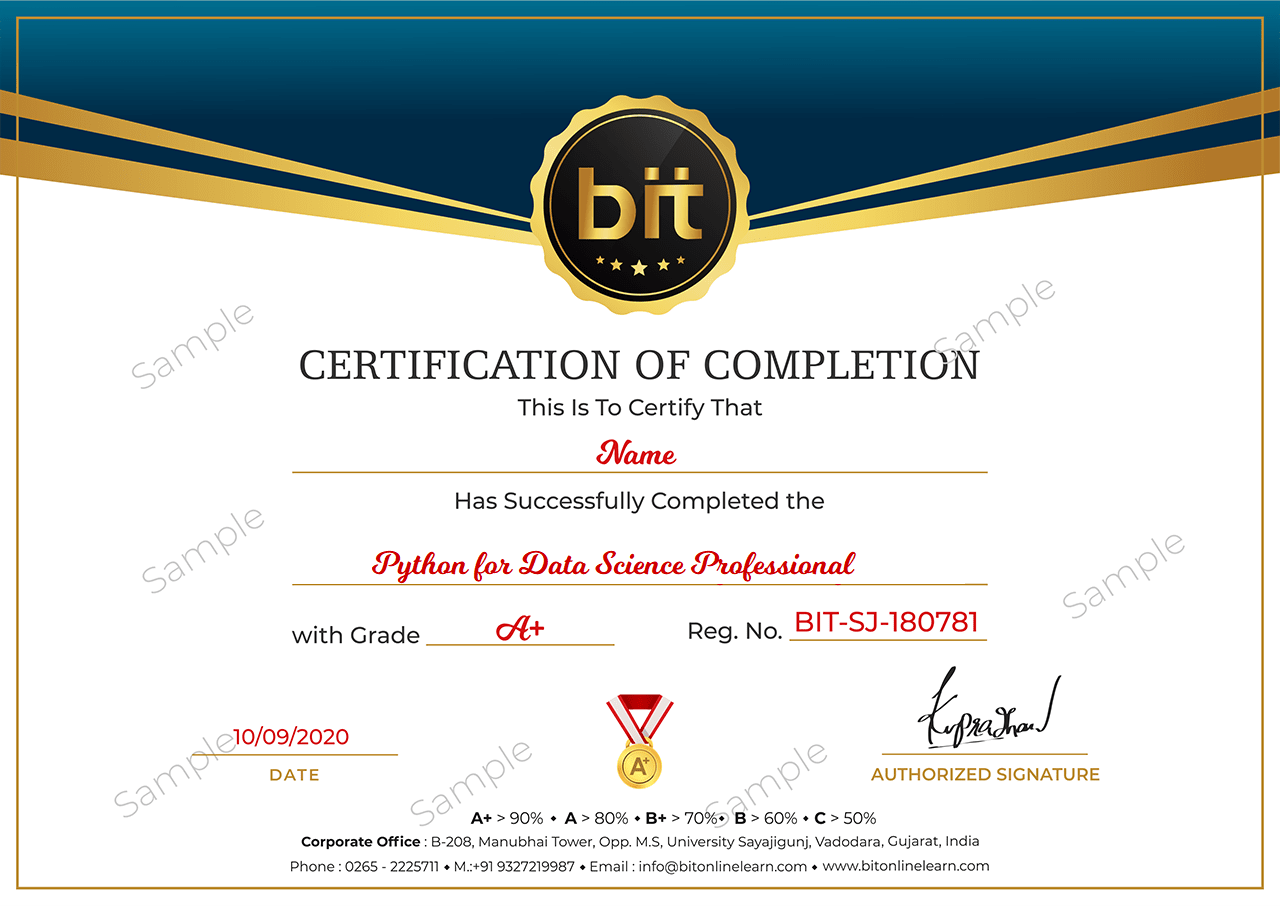
  • Certification & Job Assistance
  • Free Access to Workshop & Webinar
  • No Cost EMI Option


Have Query ?

What you will learn

  • To perform scientific & technical computing using SciPy package & its sub-packages such as Integrate, Optimize, Statisti...
  • Perform data analysis and manipulation using data structures and tools provided in Pandas package
  • Gain an in-depth understanding of supervised & unsupervised learning models like linear & logistic regression, clusterin...
  • Use Scikit-Learn package for natural language processing
  • How to use the matplotlib library of Python for data visualization
  • Extract useful data from websites by performing web scraping using Python
  • Integrate Python with Hadoop, Spark, and MapReduce
  • Master's concepts like Regression, K-Nearest Neighbors, Naive Bayes, Neural Networks Clustering, Network Analysis, Clas...

Requirements

  • basic understanding of Computer Programming Languages.

Description

|| About Data Sceince with Python Training Course

The Data Science with Python online training course will give you a detailed overview on developing machine learning using python covering the topics like regression, Naive Bayes, Clustering, tensor flow etc. The Data Science with Python course has been designed to provide in-depth knowledge of the various libraries and packages that are required to perform data analysis, data visualization, web scraping, machine learning, and natural language processing using Python. The data science with python course is based on the live projects, demonstrations, assignments, and the case studies to provide a hands-on as well as practical experience to the aspirants. Moreover, the course insights on PROC SQL and other statistical procedures such as: PROC MEANS, PROC FREQ, etc. along with the advanced analytics techniques to have a clear vision of decision tree, regression and clustering.


BIT’s Data Science with Python gives you broad exposure to key concepts and tools from Python, Machine Learning, and more. Hands-on labs and project work in this Data Science certification program bring the concepts to life with our trainers and teaching assistants to guide you along the way. Data Science is one the hottest careers of the 21st century with an average salary of 120,000 USD per annum. Data proficiency is as important as computer proficiency was 20 years back. Huge investments in analytics by top companies such as Google, Facebook and Amazon are creating millions of jobs. This full course on data science gives you an in-depth understanding of the programming and statistics basics that are required to build a strong foundation and start your journey towards becoming a data scientist. The course explains the basics of Python programming and the various packages required for data science. It also covers statistical distributions and uni variate, bi variate and multivariate statistics. You will then learn a fundamental data science technique called regression. You will be introduced to various types of regression and understand how to solve business problems using these techniques. The entire course is experiential and hands-on and involves solving real-world problems.

Course Content

Live Lecture

·      Different Sectors Using Data Science

·      The Purpose and Components of Python

·      The Data Analytics Process

·      Exploratory the Data Analysis (EDA)

·      EDA-Quantitative Technique

·      EDA - Graphical Technique

·      The Data Analytics Conclusion or Predictions

·      The Data Analytics Communication

·      The Data Types for Plotting

·      Practical Exercise
Live Lecture

·      Introduction to the Statistics

·      About Statistical and Non-statistical Analysis

·      The Major Categories of Statistics

·      About the Statistical Analysis Considerations

·      The Population and Sample

·      What is the Statistical Analysis Process?

·      The Data Distribution

·      Dispersion

·      Practical Exercise

Live Lecture

·         Introduction of Python

·         The Companies using Python

·         Different Applications where Python is used

·         Discuss Python Scripts on UNIX/Windows

·         Values, Types, Variables

·         Operands and Expressions

·         Conditional Statements

·         Loops

·         Command Line Arguments

·         Writing to the screen

·         Sequences and File Operations

·         Python files I/O Functions

·         Numbers

·         Strings and related operations

·         Tuples and related operations

·         Lists and related operations

·         Dictionaries and related operations

·         Sets and related operations

·         Functions, OOPs, Modules, Errors and Exceptions

·         Functions

·         Function Parameters

·         Global Variables

·         Variable Scope and Returning Values

·         Lambda Functions

·         Object-Oriented Concepts

·         Standard Libraries

·         Modules Used in Python

·         The Import Statements

·         Module Search Path

·         Package Installation Ways

·         Errors and Exception Handling

·         Handling Multiple Exceptions

Live Lecture

·      Introduction To Statistic

·      Distributions and Hypothesis Tests

·      Distributions of One Variable

·      Hypothesis Testing

·      Typical Analysis Procedure

·      Data Screening and Outliers

·      Normality Check

·      Hypothesis Concept

·      Errors

·      p-Value

·     Sample Size

·      Chi Square

·      ANOVA

·      Practical Exercise